I mentioned previously my compulsion to practice leeward mark roundings. Although I admit it is odd, there are times when it can pay off. Continue reading
Author Archives: Damian Lord
The Cong to Galway Race 2021 – The Final Leg
If you missed the first two parts of this review of the Cong Galway Race 2021, you can find them here and here.
After an all-too-short lunch, we all launched again ready for the second leg. As I headed back to the boat I noticed the Irish Language news crew were on the pier, and they covered the race on their news bulletin that day.
I was making headline news as usual.
The start for the second and final leg was a reaching start straight toward a narrow-ish gate. between a big rock/island and the shore, It was a bit of a judgement call as to where to start – the windward end was obviously appealing, but I felt it could easily turn into a bit of a battle, and only the winner would leave with clear air. Also, the angle of the line meant that the reach from the top end of the line to the gate would be quite broad, and a start from lower down the line would provide a quicker sailing angle for my Laser.
Having decided all this, I got my transits and aimed to start as high up the line as I could without being in the shadow of the boats duking it out to win the end. And, as much by good luck as good management, I timed it well and, as we raced down towards the first gate, I realised I was leading the monohulls – even ahead of those speedy Fireballs.

A picture of me actually ahead of the Fireballs (for a while, anyway)
Just as I was starting to imagine myself explaining my starting tactics to the sailing press, and how word would spread to the SailGP teams that I was a master tactician, and how the America’s Cup teams would then be vying for my signature, I noticed my hand was feeling a bit funny. I thought there was some problem with my glove, until I realised that my left hand was cramping up from all the sheeting. Not good news two minutes in to a 2-hour+ leg.
A bit of stretching on the deck helped ease it, and I would continue to have to do it for the remainder of the leg, but I am a brave little soldier so I carried on.

I kept the Fireballs behind me for a bit, but they eventually got past, and from then on my aim was to keep as many monohulls behind me as possible. As we wound our way down the narrow channel to the Lower Lake this was reasonably straightforward, but once the water opened out it became a little harder. The classic problem of the breeze coming down the racecourse when on a run was bound to happen, and this (coupled with the fact that the guys behind me were better sailors than me…) meant that a handful of boats closed the gap.
Rob and Rían caught me in their 420 and decided to try and roll me. But, as they had a spinnaker, I decided that a severe luff would probably be enough to put them off. Luffing matches aren’t much use to anyone in a PY race, so eventually we agreed that they’d go low and I wouldn’t go down enough to steal their wind should they get past me. It meant at least we could both keep sailing fast in clear air, and it wouldn’t damage our overall times too much.
By this stage I was now cramping in both legs as well as in my left hand – a sign that Lasers are essentially torture machines, that my fitness needs a bit of work, and that I probably hadn’t drunk enough water.
Thankfully we were heading into the last part of the race, down the River Corrib and into the heart of Galway City. This was a real test of temperament, as the tree-lined shore cut out most of the falling wind, and zephyrs of breeze could see boats steaming ahead, only to stop dead and have other boats catch them straight back up again.
My gravel pit sailing experience, coupled with my time sailing on the Norfolk Broads should have given me a bit of help here but, truth be told, I probably lost more time than I gained on the guys around me. By this stage though, I wasn’t too worried, as I was just pleased to be finishing in what I felt would be a respectable enough position. I was sure I would be in the top half of the fleet, and might even scrape in to the top 10, but it was just impossible to judge over such a long race.
After the finish, which had a small crowd of Galwegians cheering us in, and at which I beat the other Laser by exactly 3 seconds after a two-and-a-quarter hour leg, we had to capsize to get under the main road bridge over the Corrib.
As I was drifting under the bridge I saw my family on the bank of the river – still talking to each other, which was good to see. They met me at the slipway with my trolley, and the first thing they said, to greet me after my 30 nautical mile journey was:
“What the hell is going on with your face?”
With the rush to get launched, I had hurriedly put some sun cream on before leaving. I then forgot all about it – never topping it up at any point. My face was bright red, and would take days to recover.
There was a gathering for food an drink whilst the results were calculated, and the first pint of beer was unbelievably delicious – it hardly touched the sides going down. After chatting with a few sailors – all of whom asked why my face was glowing – I noticed the kids were getting a bit restless. It had been a long day for them too, so we decided to hit the road for home.
On the drive, my phone started pinging with messages from sailors from my club. Rob and Rian had only gone and won the whole event – a massive achievement. And I had snuck in to third place! Much, much better than I had hoped for.
I was sorry I hadn’t waited for the prize giving.
The prize for first place was a trophy and a night in Ashford Castle – a five-star hotel.
The prize for third place? A mug for my tea. I can tell you that, whilst I was a basking in the glory of my third place, my wife was pretty grumpy that I hadn’t sailed a little bit faster and won a night of luxury mixing it with the rich and famous.
Maybe next time.
Someone else did a write-up of the event (which is a lot better than mine…) here. And it includes this YouTube collection of pictures from the day:
Cong to Galway Race 2021 – The First Leg
If you haven’t read part one about the Cong to Galway Race 2021, then I recommend you give it a read before starting this part.
As I sailed out to the start line a few things began occurring to me that I probably should have thought about before. I had been so caught up in the logistics of the event that I hadn’t paid much attention to the race itself. A cursory read-through of the sailing instructions meant I knew the basics, but I realised I hadn’t looked up which flag was the class flag and, whilst I could figure out the start line and first mark, after that I didn’t really know where I was going.
Of course, in the build up I hadn’t worried too much about that as I knew there would be catamarans and Fireballs and other fast boats that would leading the way, but I now realised that knowing the rough direction that I should be heading was not all that helpful when trying to make decisions about the best way to get there:
- How do you know which side of the run you should aim for if you don’t know exactly where the next mark is?
- Are the cats going to zigzag downwind as I would expect, or will they sail dead downwind as some were discussing before we launched?
- Would the Fireballs sail at a broad reach angle or are they quicker to just look for puffs and soak as low as possible?
What I did know was that the keelboats were due to start before us, so I checked out the line bias (pin end favoured), the course bias (more breeze on the right), got a couple of transits, and tried to make sense of the flags as there was definitely action on the committee boat.
I sailed about checking tactical compass readings and sail set-up for the short first beat, then sailed back towards the line only to notice that there was a Preparatory flag up. For the second time.
Hmmm.
And the Class Flag was definitely different from the last time.
Hmmmm.
As Rob and Rían (from my club) sailed past me in their 420 looking fairly serious about things I decided I should probably ask if we were about to start.
We were, in about 3 minutes.
Ooof.
Rían, being the gentleman he is, gave me a quick count so I could set my watch, but it is tricky to do in a hurry so I only had a rough idea as to when the gun would go. I got into position and went as well as I could but my start was only so-so. There was a short beat to the windward mark and then we set off on the race proper bearing away to the south to run down the lake before rounding an island and heading south east on a beam to broad reach.
The first half of this leg was pretty much a drag race, and the fact that the first portion was a dead run suited the monohulls a lot better than the cats. As we turned from the run to the reach the Fireballs had smoked off into the lead, and I was still right up with, and even ahead of, a good portion of the catamaran fleet. I had no idea what the PY differences were, but I knew that it meant they had a bit of work to do to get ahead on corrected time.
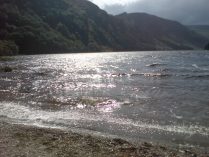
Most of these thoughts were fairly fleeting, though, because it was impossible to avoid being distracted by the surroundings. Living so close to Lough Corrib I had been on the lake several times before, but it is always breath-taking, and it is really something special to be sailing in a fleet of 40 boats in perfect conditions.
As the first leg went on some of the physical challenges became more apparent. Ninety percent or more of the first leg of the race was going to be sailed on one tack and, whilst there was very little close hauled hiking, there was a fair amount of reaching hiking, and a lot of in-and-out, fore-and-aft shifting to keep the boat planing as much as possible in the marginal conditions. Wind shadows and wind bends, thanks to the scattered islands and trees on the shoreline, meant there was little rest, and my legs and arms were starting to tire well before the end of the one-and-three-quarter hours it took to complete the first section.
And close competition also kept the pressure on. Had I had any idea about the various PYs of the other boats (which thankfully I didn’t), I would have lost any sense of the overall timing within the first 20 minutes anyway – it is simply impossible to know how you are doing with such a spread of relative speeds. Instead I had a decent battle with a very fast RS200, a 420 and another Laser who was keeping me honest.
We all tied up on a well-sheltered pier and I tried to behave as though I was fine despite my hip-flexors, quads and forearms all feeling the pain. And we were only half way there…
The Cong to Galway Race 2021 – Before the Start
This coming weekend, a great event is scheduled (weather permitting) to take place in the West of Ireland. Back in 2021 I got to take part in it, having wanted to do so since I’d first heard about it 7 or 8 years previous. The Cong to Galway race is apparently the longest inland sailing race in Europe, and it was established back in 1882, making it Ireland’s oldest inland race too. It was a big social event in the region up until the World Wars, when it dwindled out of existence around 1931 and was not re-established until 1972.
The original format involved sailing from Galway City to Cong and back again – a round trip of 60 nautical miles, and fairly solid proof that people in olden times were completely bonkers. Thankfully the new version goes just one way – starting near Cong just off the shore of the wonderfully scenic Ashford Castle and finishing in Galway City at the Quincentennial Bridge – a somewhat more manageable 30 nautical miles.

Of course, being a one way race, it is something of a logistical nightmare to take part. You have to launch in one place and recover in another – so things like trolleys and road trailers need to be manoeuvred within a specific time frame. In many ways the Cong Galway race is less a test of sailing skill and fitness and more a test of marital negotiation skills.
However, for a forward planner like myself, this was no issue at all. Over four decades before I took part I had the good sense to arrange to be born on the weekend that the 2021 race was to run, so I was able to ask for help as a birthday treat. And so it was that, whilst I sailed on one of the most beautiful lakes you can imagine in sparkling sunshine and a solid force 3 to 4, my wife and children spent large portions of the day in the car, ferrying a Laser trolley from one place to another, a task which I think they found tremendously character-building.
To be honest, it wasn’t all champagne sailing for me either. I like to consider myself as someone who can see potential pitfalls in advance, whilst most other people that know me tend to say I’m a worrier or a catastrophist.
(In fact, many years ago I remember a conversation with some friends and someone asked who among us would be which Star Wars character. Being incredibly good looking I confidently waited for someone to say that I would obviously be Han Solo, but one of my (now ex-)friends said he thought that I would be C3PO. And everyone immediately agreed. It was quite the jolt.
Wrong though they are, I can sometimes see why they might think that – the Cong-Galway race being a case in point. I hadn’t done a load of sailing over the preceding year and this, coupled with the fact that I hadn’t done an event for the guts of a decade, meant that I was frantically trying to remember / figure out all the things I’d need to do and to bring in order to get there, sail, and get home in one piece. Overall I did quite well, with one glaring exception, more of which later.
If I was nervous about the day ahead, those nerves dissipated thanks to the stunning drive to our set off point at Lisloughrey Pier. I’m lucky enough to live on the edge of Connemara, so my journey took me through the Maam Valley and, as I had left with plenty of time (for a change), I even had time to stop and take a quick photo:

Not a bad start to the day
The atmosphere around this kind of event is pretty special – there’s a fair bit of nerves and for many (including me) it is less a race and more something of an adventure. First timers like myself have no real idea what to expect and, as my cunningham had snapped the week before, I was mostly hoping that the boat and my fitness would hold together until the finish line.
Others are a lot more competitive – many have done the event several times and the reigning champion, Yannick Lemonnier and his son Sean, is a 5-time Figaro sailor, so he knows his way around a boat. He wasn’t able to race this year though, so the path was open for a new champion.
So that dominated the chat as we prepared to launch – everyone quietly guessing whether the conditions might favour their particular boat’s Portsmouth Yardstick and give them a shot at the big prize…
How To Keep a Good Lane Using the Boats Ahead
It may occur to some of you that I watch a lot of videos about recovering from a bad start. You may even wonder why that is.
I would prefer not to answer that question and, to be honest, I think it is pretty rude of you to bring it up.
We’re so lucky these days to have great coaches available to us 24/7, with videos about pretty much any issue you can imagine.
Steve Hunt is one of these guys, and his stuff is always worth watching.
This is another great one with loads of fantastic tips and advice. But, as he often does, he throws in some real gems, almost as an aside. Take this little pearl (starting at 4min 25sec):
I have never come across this advice, and never thought of it myself. I suspect it works better in the top half of the fleet – sometimes the bottom half aren’t as observant, and tack into bad lanes – there’s not much you can do about that.
But, generally speaking, this is a really useful idea when looking for a good lane, especially when you are trying to come back from a poor start, or looking to work your way up the fleet in a crowded, mid-fleet position.
Of course, the rest of the video has some good advice too. Key points he makes are:
- Do not tack and do huge ducks. Small ducks of first row boats is ok, but big ducks of second or third row boats is not.
- Find the seam – find a spot where you’re on someone’s hip with no lee bow and sail fast for a little bit. Other boats will start to fall behind as they sit in worse spots or tack too much to get out of bad spots. Then you can “look around for more wind and sail towards the mark”.
- Use the boats ahead as wind indicators – a lot of us know we should do this, but how many actually do? I like his arrow idea – worth a try, especially for the more visual learners among us.
- Go straight at the top mark to clear the bad air, then engage your strategy for the leg (unless there is a good reason to do otherwise).
Spiders Can’t Climb Stairs
Some years ago I was living in a shared house. I was sitting in the living room with a couple of friends (doing something constructive like watching TV or playing Goldeneye on a N64) when my girlfriend rushed in.
“There’s a spider in our bedroom!” She announced, looking at me.
I stood up purposefully and prepared to stride upstairs manfully and deal with the situation, when a house-mate spoke up.
“I wonder how he got there.” He mused. Continue reading
Recovering From An It-Could-be-Worse Start
First off, I want to make clear that this is a really good video. Well worth watching, and I’ll come to the reasons why in a minute.
However.
I do wonder if this guy knows what a bad start is. I mean, sure, being in 35th one third of the way up the first beat isn’t a good start. But I have had starts where I’ve been upside down when the gun goes. Or where someone has their mainsheet wrapped around my wind indicator. Or where I’m trapped outside the pin end, in irons, and half full of water.
Or where I’ve been upside down when the gun goes, right the boat only for someone to get their mainsheet wrapped around my wind indicator, then get trapped outside the pin end, in irons and half full of water.
OK,, so that last one has happened yet, but it really just feels like a matter of time…
So having someone steal my Continue reading
Reading Shifts and Puffs (Olympic-Legend-Style)
I’ve written a little about what it takes to be a good crew before. And you don’t get much better at crewing than Will Ryan.
The video below is interesting to me because it backs up some of the things I learned from sailing with an excellent crew, and it also reminds me of some other sailing wisdom.
As those that have read this site before will know, I grew up sailing on lakes and, for this reason, reading shifts is very natural to me. But I noticed that Continue reading
The Art of Being a Good Crew
Several years ago the club I was sailing at was holding one of its annual events – a GP14 regatta. Someone at the club asked if I’d like to sail in it, as one of the other members had a GP14 but wasn’t going to be taking part, meaning I could helm the boat if I could find a crew. I jumped at the chance, even though I hadn’t really sailed a two-man boat for 15 years, and I had virtually no experience with a spinnaker.
As luck would have it, another club member overheard the conversation and offered to be my crew. This was both excellent news and terrible news. The guy in question had won a world championship as a crew in a two-man spinnaker boat. I was going to have an excellent team mate, but I was also going to have no excuses for doing badly. And I like having excuses. Continue reading
Rob Wilson
All the way back during the last America’s Cup, I was watching the press conference after Day 1 of the Prada Cup Round Robins (which is a perfectly normal thing to do), and I was delighted to hear Ben Ainslie mention Continue reading